It was the month of June, when nature begins to shift its mood—from the relentless heat of summer to the soft embrace of rain. The evening breeze carried a gentle promise, occasionally whispering of the monsoons’ arrival, like a lover teasingly awaiting a reunion.
In the heart of Ahmedabad, nestled between the bustle of colleges, offices, and the ever-persistent hum of the city, there was a garden. It was not just any garden, but a timeless oasis that had seen generations come and go, each leaving behind stories—some whispered, some shouted, and some, like the old trees around it, merely observed in silence. The garden was like an old friend who had weathered every storm, watching the city change, yet staying rooted in its own quiet way.
The trees, gnarled and wise, had grown with the city, each ring in their bark a testament to the stories they had witnessed. The grass, soft and green, still held the memory of every footstep that had crossed it, every soul that had rested upon it. And the benches—oh, those benches—though worn by time, still offered the same comfort to those who sought solace in the rhythm of the leaves and the distant hum of life around them. The shine of the past may have faded, but the essence of the place, its quiet presence, remained unwavering.
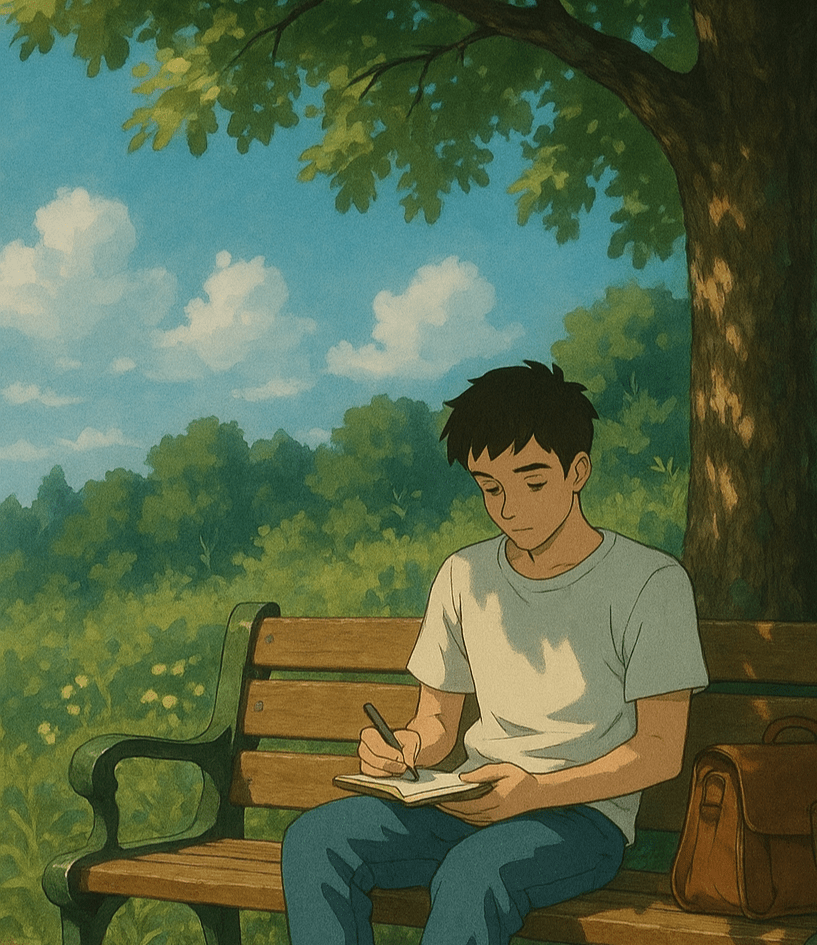
Mayan was a young man in his twenties, with a quiet, almost gentle presence. His eyes, though often lost in thought, held a certain depth that suggested a world far removed from the ordinary hustle of everyday life. Every day, without fail, between 3 and 5 PM, he would appear in the garden, as though drawn by an invisible thread.
He had a favorite bench—one that stood beneath a sprawling neem tree. The tree’s branches spread wide, casting dappled shadows across the bench: one side bathed in sunlight, the other in the cool shade. The bench itself was old, its once vibrant sky-blue paint now chipped and worn, as if time itself had left its mark. Rust clung to the edges of the metal, and some parts of the bench were broken, though still functional. A few noticeable voids where bolts had loosened gave the bench a personality of its own—a thing that had seen many years and lived through it all.
For Mayan, this bench wasn’t just a place to sit—it was a companion, a silent witness to his thoughts. If someone occupied it before he arrived, he wouldn’t sit elsewhere. Instead, he’d stand by, patient, almost as if waiting for the bench to welcome him back, and once it did, he’d settle into it as if it were a long-lost friend.
He carried with him a small leather bag—worn at the edges, much like the bench—containing a weathered diary, a novel, and a few stationary items. His ritual was simple, yet profound: he would spend hours sitting there, staring at the sky, letting the wind ruffle his hair, or observing the people passing by. He’d often write in his diary, his pen gliding across the pages, as though capturing fleeting moments that meant more to him than words could say.
For an hour or two, the world around him would fade into a blur, leaving only the soft scratch of his pen on paper and the rhythm of his breathing. But every time he left, there was a certain sadness in his eyes—a quiet resignation, as though he were leaving something behind, something that was never truly his to keep.
 Unheard from Shubh
Leave a comment